Daily habits keep the immediate work moving, but they're bad at catching slower-moving problems — a client relationship quietly cooling off, an invoice that's overdue and forgotten, a project that's technically on schedule but has quietly drifted from what was actually agreed. A weekly review is where those things get caught, because it's the only regular moment built specifically for looking at the whole business instead of the next task.
- Twenty minutes a week catches the slow problems that daily routines miss.
- Follow the same order each time: backlog, clients, money, next week.
- Write down one priority for the coming week, and stop.
Why daily systems aren't enough on their own
The daily close-out habit is good at answering "what needs to happen tomorrow." It's bad at answering "is this client relationship going well," "am I on track financially this month," or "have I let something slide for two weeks without noticing." Those questions need distance from the day-to-day to actually see clearly, which is exactly what a weekly review provides.
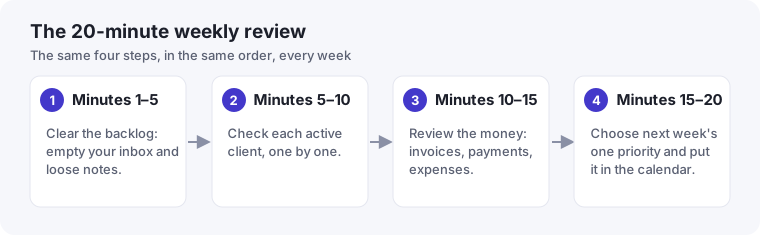
A 20-minute weekly review structure
Minutes 1-5: Clear the backlog
Go through your single inbox and task list and clear out anything stale — completed items still marked open, requests that turned out not to matter, duplicate entries. A cluttered system makes the rest of the review harder than it needs to be.
Minutes 5-10: Check every active client, one by one
For each current client, ask three questions: is this project on track, is there anything I'm waiting on from them that's been stalled too long, and have I heard from them recently enough that the relationship still feels active. This is where you catch a client who's gone quiet before it becomes an awkward follow-up email a month later.
Minutes 10-15: Review money, not just tasks
Check which invoices are outstanding and how overdue they are, and glance at upcoming income against upcoming expenses. Freelancers who only look at this monthly or "when it feels necessary" are far more likely to be surprised by a cash flow gap than freelancers who glance at it weekly, even briefly.
Minutes 15-20: Set the coming week's one priority
Beyond the day-to-day client deliverables, pick one thing for the business itself — updating your portfolio, following up with a lead that went cold, revisiting your rates. This is the category of work that's never urgent on any given day and therefore never happens unless it's deliberately scheduled.
Making the habit stick
Weekly reviews fail most often for one of two reasons: they're not scheduled at a specific, recurring time, so they get skipped whenever the week gets busy — which is precisely when they matter most — or they balloon into an hour-long deep dive that feels like too much of a chore to sustain. Keep it to a fixed 20-minute block, same day and time every week, and resist the urge to turn it into a full planning session. Depth is what the daily close-out and monthly review are for; the weekly review's job is breadth — a quick scan across everything, not a deep dive into any one thing.
What to do when the review surfaces a problem
The point of catching something during a weekly review — a client who's gone quiet, an invoice two weeks overdue, a project quietly off track — isn't to solve it during the review itself. Note it, and schedule a specific action for it in the coming week. The review's job is to surface problems while they're still small and easy to address, not to become a second full working session on top of your actual client work.
A consistent weekly review is one of the highest-leverage habits in this entire system, precisely because it's the one place built specifically to catch what the day-to-day rhythm is structurally bad at noticing.
What to track over time, not just in the moment
A single weekly review is useful on its own, but the real value compounds when you keep a simple running log of what came up each week — even just one line per client, or a note about a recurring problem. After a month or two, patterns become visible that no single week would reveal: a particular client who always seems to go quiet mid-project, a type of request that keeps generating scope creep, or a slow month that turns out to follow the same seasonal pattern as last year. None of this shows up if the review happens but nothing from it is retained.
Adjusting the format as your business changes
The structure above assumes a handful of active clients and a fairly simple business. As you take on more clients, add a subcontractor, or start managing recurring revenue instead of one-off projects, the 20-minute format may need to expand slightly — but resist the urge to let it balloon indefinitely. If the review is consistently running long, that's usually a sign some of what you're doing weekly would be better handled with a lighter daily check instead, freeing the weekly slot to stay focused on the bigger-picture questions it's actually good at answering.
Pairing it with a lighter monthly check-in
Some things genuinely don't need weekly attention — reviewing your rates against the market, checking overall business trends, or deciding whether to raise prices for new clients. A short monthly review, separate from the weekly one, is a natural place for these slower-moving questions. Keeping the two separate stops the weekly review from expanding into something you start avoiding, while still making sure the bigger strategic questions get revisited on some regular cadence instead of "whenever it comes to mind," which for most freelancers means rarely.
Questions that catch drift
The best reviews include a few questions that pull you out of task mode. Add these to the client step, and answer each in a sentence or two:
- Which client have I not spoken to in a while, and is that intentional?
- Is any project quietly moving away from what we originally agreed?
- Where did I say yes this week when I would have preferred to say no?
- What took much longer than I expected, and why?
- What is one thing I would like to stop doing?
A sample review entry (hypothetical)
Keeping a short written record helps you see trends over months. An entry might be as brief as this:
Week 14. Cleared inbox; three invoices sent, one overdue by five days (reminder sent). Client A is waiting on my revision, Client B has gone quiet, so I will check in Monday. Two small requests absorbed from Client C; noted that this is the third time. Next week's priority: finish the draft for Client A before Wednesday.
Notice that it contains facts and decisions, not reflections. After a few months, scanning the entries will show recurring patterns, such as a client who often goes quiet or a type of task that always overruns.
Make it survive a busy week
The weeks when you most need a review are the weeks when you feel you have no time. Keep a five-minute version for those: check money, check deadlines, choose one priority. Shortening the review keeps the habit alive, while skipping it breaks the chain. Put it in your calendar as a recurring appointment with yourself, and treat it with the same respect as a client call.
Add a monthly look
Once a month, extend the review by ten minutes to look at the bigger picture: income against your target, how your time was split between clients, and whether your rates and terms still fit the work. Our guides on tracking billable hours and structuring rates pair well with this monthly check.