Most freelancers avoid setting boundaries because they picture it going badly — a client getting offended, a project ending, a difficult conversation with no good outcome. In practice, the opposite is usually true: clients who get vague, resentful compliance from an overworked freelancer notice it eventually, while clients who get a clear, professional boundary stated early tend to respect it and adjust. The relationships that actually end badly are usually the ones where a boundary never got set at all, until frustration built up and came out sideways.
- Boundaries work best when they are stated at the start, in writing, and framed as how you deliver good work.
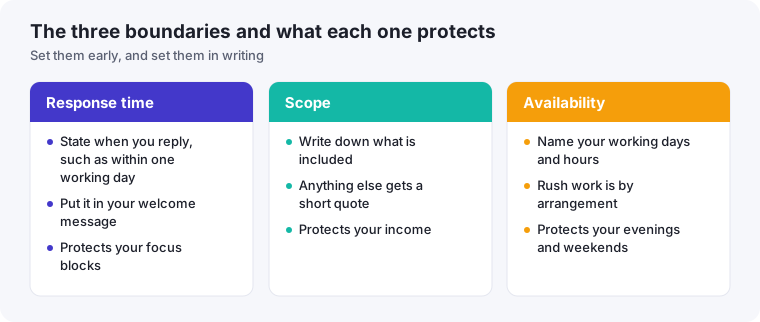
- The three most useful ones are response time, scope and availability.
- If a client keeps crossing a boundary, respond in steps, and review whether the relationship fits your rates.
Why boundaries protect the relationship, not threaten it
A boundary isn't a rejection of the client — it's information that helps them work with you better. "I don't take calls after 6pm" isn't a wall; it's a fact that lets a client plan around your actual availability instead of guessing and occasionally guessing wrong in a way that annoys you both. Clients generally aren't trying to take advantage of you; they simply don't know where your limits are unless you tell them, clearly and early, before resentment has a chance to build.
The three boundaries that matter most for freelancers
1. Response time expectations
Without a stated boundary, clients calibrate their expectations based on your fastest-ever response — the one time you replied in ten minutes becomes the baseline they expect every time. State your actual response window up front (for example, within one business day) so a slower response later isn't read as you dropping the ball.
2. Scope boundaries
"Can you also just quickly add..." is the most common boundary test in freelancing, usually not asked in bad faith — clients often genuinely don't know that a small-sounding request is actually a meaningful chunk of work. A clear scope boundary, stated as a simple fact rather than an accusation, keeps small asks from quietly becoming unpaid project expansion.
3. Availability boundaries
Evenings, weekends, and vacation time need to be stated as unavailable, not just personally intended as unavailable. An unstated boundary gets tested by default, not out of malice — most clients will use whatever channel gets a response, and if evening messages get evening replies, that becomes the expectation going forward.
Communication templates that keep it professional
Setting a response-time expectation (in your welcome message)
"Just so you know how I work: I typically respond to messages within one business day. For anything genuinely time-sensitive, flag it as urgent in the subject line and I'll prioritize it."
Pushing back on scope creep
"Happy to add that — it's a bit outside what we originally scoped, so I'll send a quick estimate for the extra time before I start, just so there are no surprises on the invoice."
Protecting off-hours time
"I'm offline evenings and weekends to stay sharp for client work during the week — I'll get back to you first thing the next business day."
What to do when a client pushes back anyway
Occasionally a client will test a stated boundary directly — asking for a weekend call despite your stated hours, for example. The response that preserves the relationship is calm and consistent, not defensive: restate the boundary once, offer the actual available alternative, and follow through on it. Clients who repeatedly and deliberately ignore clearly stated boundaries after this are revealing something important about how the working relationship will go long-term — that's useful information, even when it's uncomfortable to receive.
Timing matters as much as wording
Boundaries land best when stated proactively, during onboarding, before there's been a violation to react to. A boundary introduced for the first time after a client has already crossed it reads as a complaint, even when it's phrased identically to one stated upfront. This is one more reason a solid onboarding process pays off — it's the natural moment to set expectations before any pattern has had a chance to form.
The freelancer's fear behind avoiding boundaries
Underneath most boundary-avoidance is a specific fear: that stating a limit will cost you the client, especially early in a freelance career when every client feels irreplaceable. It's worth naming this directly, because it drives a lot of bad decisions — working weekends without being asked to, absorbing scope creep silently, answering messages at 11pm to seem responsive. The irony is that these behaviors don't actually make clients more loyal; they make you more replaceable, because you've demonstrated that your limits move under any amount of pressure, which trains clients to keep pushing.
A different way to think about "difficult" clients
Freelancers often describe a client who pushes on boundaries as "difficult," but it's worth separating two very different situations. Some clients push because no one has ever told them where the line is — once a boundary is stated clearly and calmly, they adjust without friction, because they were never trying to cause a problem. Others continue pushing even after a boundary has been clearly and repeatedly stated. Only the second group is actually a difficult-client problem; the first is simply a communication gap that a clear boundary solves on the first try.
Building this into your rates, not just your schedule
Boundaries aren't only about time and availability — pricing is a boundary too. A rate that reflects your actual value, stated confidently rather than apologetically, is itself a form of boundary-setting. Clients who balk hard at a fair rate are often the same clients who test every other boundary later. Treating your rate as non-negotiable in the same calm, factual way you'd state a response-time policy tends to filter for clients who respect limits generally, before the relationship even starts.
Write down your current unwritten rules
Most freelancers already have boundaries; they just haven't said them out loud. Spend ten minutes writing answers to these prompts: When do I answer messages? What kinds of requests do I always say yes to, and which ones make me resentful? What time of day is my best work, and who currently interrupts it? Which client behavior makes me dread opening my inbox? The answers show you which boundaries matter most to you, and give you the wording to communicate them.
An escalation ladder for repeated crossings
When a client keeps crossing a line, jumping to a confrontation is rarely necessary. A gradual approach protects the relationship and gives you clear evidence about what the client will accept:
- Restate the boundary calmly. "As a reminder, I reply within one working day, so I'll get back to you tomorrow."
- Offer an alternative that works. "If it's time-sensitive, I can take it on as a rush job with a rush fee."
- Put the boundary in writing. Send a short message summarizing the working arrangement you both agreed to, and ask for confirmation.
- Adjust the terms. If the pattern continues, consider a higher rate, a retainer that includes availability, or a reduced scope.
- Decide whether to continue. Some clients are not a fit at your rates. Ending the relationship politely is a legitimate choice, and protects the time you need for better clients.
Boundaries you can price
Some boundaries are easier to hold when they come with a price attached. Instead of refusing evening or weekend requests entirely, you might offer them at an agreed premium, which lets the client decide whether it is worth it. Similarly, a monthly retainer can include a defined number of hours and a faster response time. This turns "no" into "yes, and here is how that works", which clients tend to receive far better.