Scope creep rarely arrives as an obvious, unreasonable demand. It usually arrives as a series of small, individually reasonable-sounding requests — "can we also just," "while you're in there," "one more small thing" — that collectively add up to meaningfully more work than what was originally priced. The challenge isn't identifying scope creep after the fact; it's catching it in the moment without turning every small request into an uncomfortable negotiation.
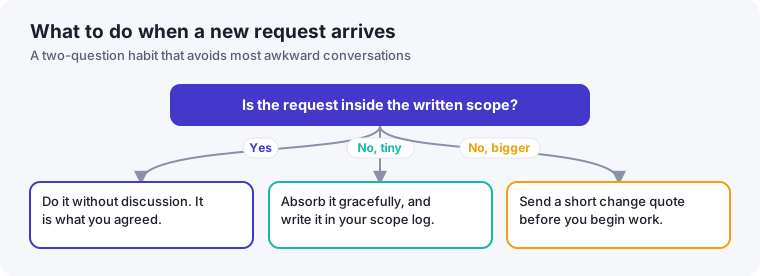
- Compare each new request against the written scope before you answer it.
- Absorb genuinely tiny requests, but keep a log so you can see patterns.
- For larger requests, send a short change quote before you start, not after you finish.
Why scope creep is rarely bad faith
Most clients aren't deliberately trying to get free work — they genuinely don't have a clear sense of how much effort a given request takes, especially for skilled work they don't do themselves. A design tweak that sounds trivial to describe can represent hours of actual work depending on how it's implemented. Approaching scope creep as an information gap rather than an attempt to take advantage of you leads to much better conversations than approaching it defensively.
Catching it early: the scope check habit
Before agreeing to any request that comes up mid-project, ask yourself one question: was this part of what we originally scoped? If the honest answer is no, say so in the moment, calmly and factually, rather than doing the work first and bringing up scope after the fact — by then, it reads as a surprise charge rather than a heads-up, even if you're completely right that it's outside the original agreement.
A simple script for flagging scope creep
"Happy to add that — it's a bit beyond what we originally scoped, so let me send a quick estimate for the extra time before I start, just so it's not a surprise on the next invoice."
This script works because it does three things at once: agrees to help (not a refusal), states the scope fact plainly without accusation, and gives the client control over whether to proceed once they see the cost. Most clients respond well to this, precisely because it doesn't feel like a conflict — it feels like normal, professional process.
Small requests: when to just absorb them
Not every slightly-out-of-scope request needs a formal change order. Genuinely small additions — five minutes of work, a minor clarification — are often better absorbed without comment, both for the relationship and for your own sanity; flagging every tiny request as a billing event creates friction disproportionate to the actual cost. The judgment call is distinguishing a genuinely small, occasional ask from a pattern of small asks that collectively add up — the second is scope creep even if no individual request looks like it.
When scope creep becomes a pattern with a specific client
If flagging individual instances isn't fixing a recurring pattern with one client, the conversation needs to move up a level, from individual requests to the overall working relationship: "I've noticed we're consistently adding things beyond our original scope — should we look at restructuring this as an ongoing retainer instead of a fixed-scope project, so the pricing matches how the work is actually evolving?" This reframes a source of recurring friction into a structural fix, and often results in a better arrangement for both sides.
Preventing it at the source
The best defense against scope creep is a genuinely detailed scope statement in your original proposal or contract — vague scopes create more room for disagreement about what's included. Being specific about deliverables, revision rounds, and what's explicitly excluded, discussed openly during onboarding, prevents many scope conversations from needing to happen at all.
Tracking scope creep over the life of a project
On longer projects, it helps to keep a short running note of every out-of-scope request and how it was handled — absorbed for free, billed separately, or declined — even if you don't share this note with the client directly. Reviewed at the project's midpoint or end, this record often reveals a pattern invisible in any single moment: perhaps a project that looked profitably scoped at the outset has quietly accumulated enough small additions to erode the margin significantly. This is useful information for pricing similar projects more accurately in the future, independent of how any individual scope conversation went.
Scope creep from your own side
It's worth acknowledging that scope creep isn't always client-initiated. Freelancers sometimes add unrequested extra polish or additional deliverables out of a desire to impress, without adjusting the price to reflect the additional time. This has the same effect on your margins as client-driven scope creep, but is entirely within your own control to prevent — a useful check during your own weekly review is asking whether any current project has quietly grown beyond what you originally quoted, regardless of who initiated the additions.
A mini change-request template
When a request is outside the scope, the response should be quick, friendly and specific. A short structure keeps the tone neutral and gives the client an easy decision:
- Acknowledge: "Thanks for the idea. That would improve the page."
- Explain the gap: "It's outside what we agreed, which covered the three pages listed in the proposal."
- Give options: "I can add it for a fixed price, swap it for one of the existing items, or schedule it as a second phase."
- State the effect: "Adding it would also move the delivery date by about two working days."
- Ask for a decision: "Let me know which you'd prefer and I'll update the plan."
Because it presents choices, it feels like problem-solving and not a refusal. Clients who care about the project will usually pick one of the options.
A scope log example (hypothetical)
A simple log with four columns (date, request, decision, time) shows patterns you cannot see from memory. Here is what a few lines might look like:
| Date | Request | Decision | Time |
|---|---|---|---|
| Week 2 | Change one heading on the homepage | Absorbed | 5 min |
| Week 3 | Add a new page for testimonials | Quoted as extra | Estimated 3 h |
| Week 4 | Recolour all buttons | Absorbed, flagged as the third design tweak | 20 min |
If small absorbed items keep adding up, the log gives you factual, non-emotional evidence to raise the topic. You can say, "I've absorbed several small changes so far; from here I'll bundle them into a single revision round."
Prevent it in the agreement
Most scope disputes are prevented before the project starts. Spell out the deliverables, the number of revision rounds, what counts as a revision versus new work, and how change requests are handled. Then refer to that document in kickoff so everybody has read it. Our guide on setting boundaries with clients covers how to raise these points without sounding defensive.