Freelancers do a surprising amount of research that has nothing to do with their core craft: understanding a new client's industry before a call, checking a competitor's positioning, verifying a fact before including it in deliverable work. AI research tools like Perplexity have changed how much of this takes, but not universally — traditional search still wins for a specific set of tasks.
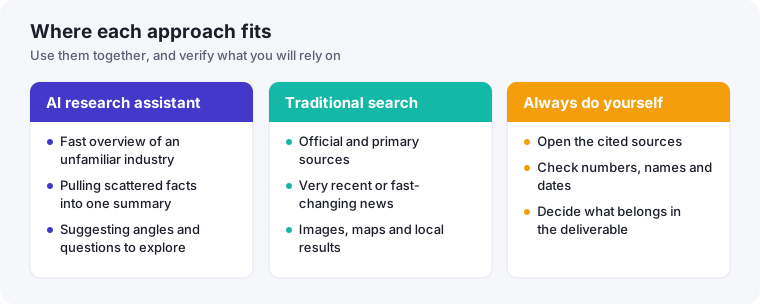
- AI research assistants are strongest at quick overviews and synthesis, and traditional search is strongest for primary sources and fast-moving topics.
- Always open the cited sources for any fact you plan to use in client work.
- Use the assistant to get oriented, then confirm the details yourself.
What AI research assistants do differently
Tools like Perplexity combine a live web search with an AI-generated summary of what it finds, citing sources directly rather than just returning a list of links to click through yourself. Instead of opening five tabs and synthesizing them manually, you get a direct answer with the sources attached — genuinely faster for a specific kind of question.
Where this genuinely saves time
Pre-call industry briefings
Before a discovery call with a new client in an unfamiliar industry, asking a research assistant to summarize the current state of that industry, common challenges, and recent developments gets you conversational context in minutes instead of the 30-40 minutes it might take browsing multiple articles manually.
Quick fact verification
Checking whether a statistic or claim you're about to include in client work is current and accurate is faster with a tool that cites its source directly, letting you click through to verify rather than searching for the original source yourself.
Synthesizing scattered information
Questions that require pulling together information from multiple sources — "what are the current best practices for X" — play to AI research tools' strength of synthesis, where traditional search just hands you the individual pieces.
Where traditional search still wins
Comparison shopping and reviews
Choosing between specific products or services where you want to browse many individual reviews, images, and comparisons yourself is still better served by traditional search — an AI summary of "the best X" can miss the specific detail that matters most for your particular situation.
Highly current or fast-moving topics
For anything changing day to day or hour to hour, going directly to a primary source — a live news site, an official announcement page — beats any summarized answer, AI-generated or not, simply because summaries are a step removed from the freshest information.
Visual and local search
Finding a specific image, browsing a map, or searching for a local business are tasks traditional search engines are built for specifically, and AI research assistants generally aren't designed to replace this use case.
The verification habit that matters regardless of tool
Whichever tool you use, treat any specific fact you plan to put in front of a client — a statistic, a claim about a competitor, a regulatory detail — as something to verify at the source, not just trust because an AI assistant cited it confidently. Citations reduce the guesswork of finding the original source, but they don't guarantee the AI's summary of that source is perfectly accurate. This is a five-minute habit that prevents the much larger problem of passing along inaccurate information in paid client work.
Using research tools to prepare for proposals
Beyond call prep, a quick research pass on a prospective client's industry or recent news before writing a proposal can meaningfully improve how tailored the proposal feels, without taking much extra time. Referencing something specific and current about a client's situation is one of the clearest ways to avoid the generic-sounding proposal problem covered in our AI proposal-writing guide — and a few minutes with a research assistant beforehand is often enough to surface that specific detail.
A caution about over-relying on any single source
Whether using an AI research assistant or traditional search, it's worth deliberately checking more than one source for anything that will inform a significant client recommendation or a claim in paid deliverable work. AI research tools are good at synthesis, but a synthesis is only as reliable as what it's built from — if the underlying sources it drew on happen to share the same blind spot or outdated information, a confident-sounding summary can still be wrong. Treat any single research pass, however well-cited, as a strong starting point rather than a final answer for anything that matters.
Building the habit into your existing workflow
The freelancers who get the most value from AI research tools tend to build a small, consistent habit around them — a quick research pass before every discovery call, for instance — rather than reaching for the tool only occasionally when something feels unusually complicated. Like most of the systems covered on this site, the value compounds through consistent, modest use far more than through occasional, intensive use.
A five-minute verification routine
Whatever tool gave you the answer, run the same short routine before a fact goes into a proposal, report or deliverable:
- Open the source. Click the citation and confirm the page actually says what the summary claims. Summaries occasionally attribute statements to sources that do not contain them.
- Check the date. An accurate statement from an old article may no longer be true, especially for prices, laws and software features.
- Prefer the original. If the claim comes from a study, a company or an official body, find that original page instead of relying on someone else's write-up.
- Look for a second source. For anything important, find independent confirmation, not just another page that repeats the first.
- Note it down. Save the link and date next to the fact so you can defend it if a client asks.
Example: preparing for a first call (hypothetical)
Imagine a freelance designer has a first call tomorrow with a small logistics company. In about twenty minutes they could ask an assistant for a plain-language overview of how logistics companies of that size tend to work and what they usually worry about, then open two or three of the cited sources to confirm the main points. Next, they would visit the company's own website and recent announcements directly, since an assistant may not have the latest information. Finally, they would write down three questions for the call that show they have done their homework. The assistant sped up the orientation; the judgment about which questions to ask remained the freelancer's.
Write better questions
The quality of an answer depends on the question. Give the assistant your role and purpose ("I am preparing for a first call with a client in this industry"), ask for the kinds of information you need (typical challenges, terminology, common misconceptions), and ask it to say where it is unsure. Follow-up questions such as "what would a critic of this view say?" are especially useful, because they push against the tendency of a summary to sound more settled than the evidence is.