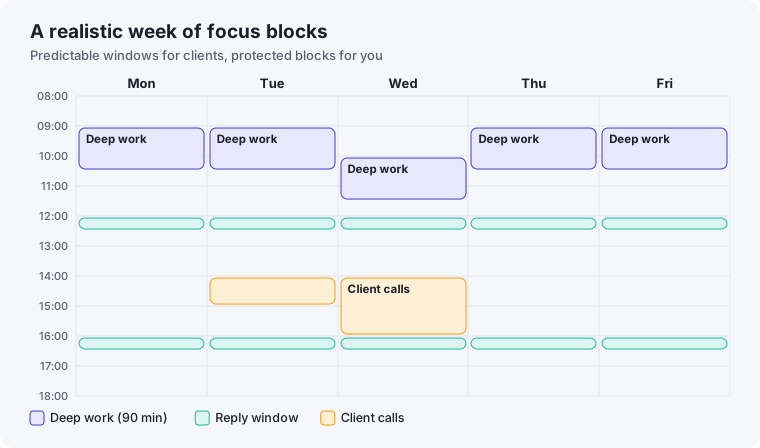
Most popular advice on deep work assumes a level of schedule control that many freelancers simply don't have — block off your mornings, turn off all notifications for four hours, disappear from communication entirely. For a freelancer juggling several active clients who each expect reasonably responsive communication, disappearing for a four-hour block can create its own problems. Here's a more realistic version.
- Shorter, more frequent focus blocks are easier to protect than a single long one.
- Tell clients when you will reply, so a quiet block does not look like absence.
- Keep one clear emergency exception, and review after a month whether the system is working.
Why the standard advice doesn't fully transfer
Deep work advice is often written from the perspective of someone with a single employer and a team that can cover for them during focus time. A freelancer has neither — going fully unreachable for a client with a genuine urgent need, even rarely, carries a different kind of relationship risk than it does for an employee whose manager can redirect the request to someone else in the meantime.
Shorter, more frequent blocks over rare, long ones
Rather than one heroic four-hour block a few times a week, many freelancers get more reliable results from two 90-minute blocks most days — long enough for genuinely deep focus, short enough that going unreachable for that window rarely causes a real problem, and frequent enough that missing one occasional block to a client emergency doesn't derail your whole week's deep work.
Communicate availability instead of disappearing silently
A block that clients don't know about gets tested by whoever happens to message you during it. A block you've mentioned as part of your normal working pattern — as covered in our client boundaries guide — gets respected far more consistently, because clients aren't left wondering whether something is wrong when you don't respond immediately.
Build in one true emergency exception
Rather than an all-or-nothing approach to reachability, decide in advance what counts as important enough to interrupt a focus block — a specific client with a live production issue, for example — and set up a way for that one exception to reach you (a separate notification channel, a starred contact) while everything else waits. This removes the anxiety of "what if something urgent happens" without requiring you to stay reachable to everyone all the time.
Match deep work blocks to your actual energy, not an ideal schedule
Advice to do deep work "first thing in the morning" doesn't fit everyone's actual energy pattern. Pay attention over a week or two to when you're naturally sharpest, and place your blocks there — a focus block scheduled at your low-energy time of day produces far less than the same length of time scheduled well, regardless of how disciplined you are about protecting it.
Accept that some days won't have one, and don't abandon the system because of it
Freelancing includes genuinely unpredictable days — a client crisis, an unexpected urgent request, a personal emergency. A deep work system that only works on perfectly quiet days isn't realistic for freelance work. Treat a missed block as a normal, occasional occurrence rather than evidence the whole system has failed, and simply pick it back up the next available day.
Recognizing when a lack of deep work is actually a different problem
Sometimes what feels like a deep work problem is actually a scheduling or client-volume problem in disguise. If focus blocks are consistently impossible to protect week after week, regardless of how they're structured or communicated, that's worth examining honestly — it may point to taking on more active clients than your capacity genuinely supports, rather than a discipline or system failure. No amount of clever block scheduling fixes a workload that structurally doesn't leave room for uninterrupted time.
Protecting deep work blocks from yourself, not just clients
Client interruptions get most of the attention in deep work advice, but self-interruption — checking messages "just quickly" during a supposedly protected block — is just as common a cause of fragmented focus, and entirely within your own control to fix. Physically removing notification access during a block, rather than relying on willpower to ignore them, tends to work far better in practice; willpower is a limited resource that depletes over the course of a block, while a phone in another room doesn't.
Measuring whether it's actually working
Rather than judging deep work by how virtuous a block felt, judge it by whether the specific task you intended to make progress on actually moved forward. A block that felt calm and focused but produced no real output is worth reconsidering just as much as one that felt scattered — the point is genuine progress on meaningful work, not simply the appearance or feeling of focus.
A simple way to check this over time: at the end of each week, glance back at what your protected blocks actually produced versus what you'd hoped for going in. Consistent gaps between intention and output usually point to a specific, fixable cause — wrong time of day, wrong task type for a focus block, or blocks that are being interrupted more often than you've noticed — rather than a sign that deep work simply doesn't work for your particular situation.
A message that explains your availability
The biggest risk of a focus block is not the block itself, but the client who assumes you have disappeared. A short note in your welcome message, or an automatic status, removes that worry. For example:
I do my main focused work in the mornings, so I reply to messages around midday and again late afternoon. If something can't wait, call me, and I'll pick up.
Notice that it gives clients both a schedule and an escape route. Most will never use the emergency option, but knowing it exists makes them comfortable waiting.
What to put inside a focus block
A protected block is only useful if you know what to do with it. Decide the night before, as part of your daily close-out, which single task the next block is for. Choose the work that needs sustained concentration and moves a project forward, such as drafting, designing, coding or analysing, rather than tasks that can be done in fragments. Keep a short list of "deep work candidates" so you never open the block wondering where to start.
Prepare for the start
- Close email and messaging apps before the block begins, not after the first ping.
- Put your phone out of reach, or in another room.
- Have the files and references you need open already.
- Write down the first small step, so starting takes no decision.
Run a four-week experiment
Instead of trying to redesign your whole schedule, run a simple test. For four weeks, protect one ninety-minute block on as many days as you can. At the end of each week, write down how many blocks you completed and what got in the way. Look for patterns: is it the same client, the same time of day, or your own habits? Adjust one thing at a time. Progress usually comes from small changes to the block's timing and the way you communicate it, not from more discipline.