Working from home removes a commute and office overhead, but it also removes the physical and social cues that used to separate work time from everything else. Without a deliberate structure, a home-based freelance workday tends to expand in both directions — starting earlier, ending later, and getting interrupted more often — while somehow producing less focused output than a shorter office day used to.
- Start and finish the workday with small, deliberate rituals, so your brain gets the cue.
- Separate work from home life with zones, even if you do not have a spare room.
- Agree a simple signal with the people you live with, so interruptions become the exception.
Why home environments fragment focus by default
An office has built-in signals that you're "at work": a location, other people also working, a commute that marks the transition. A home office has none of these automatically — the same room can mean "working," "relaxing," or "handling a household task" depending only on what you're currently doing in it, which makes it easy for the boundaries between these to blur without you fully noticing.
Creating a start-of-day boundary
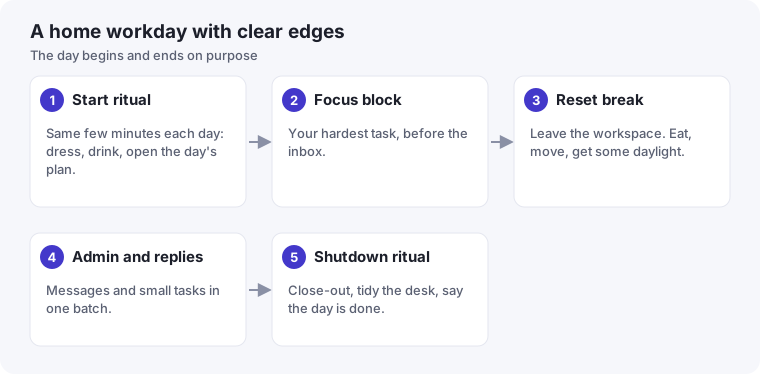
Without a commute, many home-based freelancers slide directly from waking up into checking messages, skipping any clear transition into "work mode." A short, consistent start-of-day ritual — even five minutes, like making coffee away from your desk before sitting down, or a short walk around the block — recreates some of the mental transition a commute used to provide, and tends to produce a clearer sense of "now I'm working" than opening a laptop from bed.
Physically separating work from everything else
If a dedicated office isn't available, even a consistent spot used only for work — not the couch, not the kitchen table where you also eat — helps your brain associate that specific location with focus. The separation doesn't need to be a separate room to be effective; it needs to be consistent enough that sitting there reliably signals "work" rather than "wherever I happened to open my laptop today."
Handling household interruptions without becoming unreachable
Family members, roommates, or deliveries don't know when you're in a protected focus block from our deep work guide unless you tell them. A simple visible signal — a closed door, headphones on, a small sign — communicates availability status to the people actually in your physical space, the same way stated boundaries communicate it to clients.
Building in a clear end-of-day boundary
Just as important as starting well is stopping clearly. Without a commute or a coworker leaving to signal the end of the day, work can quietly bleed into evening hours simply because the laptop is still open in the next room. A specific end-of-day ritual — shutting down fully, physically leaving the workspace, a short walk — creates the same kind of clear transition in reverse, and tends to reduce the nagging feeling of never fully being off that many home-based freelancers describe.
Matching your space to your actual energy patterns
If certain times of day involve more household activity or noise regardless of what you do, work with that reality rather than fighting it — schedule your protected focus blocks for quieter windows, and save more interruptible tasks like email or admin batching for times when interruptions are more likely regardless of your intentions.
Adjusting for shared living spaces
Not everyone working from home has the option of a dedicated room or even a consistently quiet spot — shared apartments, family homes, and small living spaces all add real constraints that generic home-office advice tends to ignore. If a fully separate workspace isn't possible, the same principles still apply at a smaller scale: a specific chair, a particular corner of a shared room, or even a consistent set of headphones used only during work hours can serve the same signaling function as a separate office, just with a smaller physical footprint.
Revisiting your setup as circumstances change
A home workday structure that works well in one season of life — no children home during the day, a quiet household — may need real adjustment when circumstances change. Rather than treating your current setup as permanent, revisit it periodically, the same way the weekly review habit revisits other parts of the business regularly. A structure that no longer fits your actual living situation tends to erode gradually rather than fail all at once, which makes it easy to keep pushing through a setup that's quietly stopped working.
A note on working from cafés and shared spaces
Some freelancers find they focus better outside the home entirely, at least for part of the week — a café, a coworking space, a library. If home doesn't provide enough separation despite trying the strategies above, this is a legitimate alternative rather than a failure to make the home setup work. The underlying goal is the same either way: a consistent environment your brain reliably associates with focused work, wherever that environment happens to be.
Zones instead of rooms
Not everyone has a separate office, and you don't need one to create separation. Think in zones. A corner of a table, used only for work and packed away at the end of the day, is a work zone. Sitting in a different place for lunch, and for reading in the evening, creates the contrast your brain uses to tell activities apart. If possible, use a different position, such as standing for calls or sitting at the desk for focused work. Small changes in posture and location carry surprisingly strong signals.
A script for interruptions at home
Interruptions from people you live with are usually well-meant and often avoidable with a clear agreement. Have a short conversation, ideally at a calm time rather than mid-interruption, and cover three things: your working hours, what counts as a genuine reason to interrupt, and a visible signal for focus time, such as a closed door or a sign on the desk. For example: "From nine to eleven I'm in focus mode. If the door is closed, it's for something urgent only. I'll be free for a proper chat at eleven." Consistency matters more than firmness; it works best when the same signal always means the same thing.
Make the shutdown ritual concrete
The end of the day is where home offices tend to leak. Keep the shutdown ritual small and specific: review tomorrow's first task, write down anything still on your mind in your inbox, close the laptop, and do a physical action that marks the end, such as tidying the desk, switching off the light or going for a short walk. If you feel the pull to "just check email", remind yourself that whatever arrives will be there in the morning, and your daily close-out has already captured what matters.
A weekly reset of the space
Once a week, spend ten minutes resetting your workspace: clear surfaces, file loose papers, charge devices and check that you have what you need for the coming week. A tidy, ready space lowers the effort of starting, and it is easier to begin focused work when nothing is asking to be dealt with first.