This article covers how to structure payment terms and invoicing practices — it isn't financial or tax advice, and if you have specific questions about your own finances, a qualified accountant or financial advisor is the right person to ask. What it can offer is a practical, operational look at why late payments hit solo freelancers so much harder than larger businesses, and structural changes that reduce how often it happens.
- A deposit and milestone payments reduce how much any single late invoice can hurt.
- Shorter payment terms and clear late-payment steps are set at the start, not after a problem.
- This is general information, and your accountant is the right person for advice on your own finances.
Why one late invoice hits harder for a freelancer
A business with a finance team and multiple revenue streams can absorb one client paying late. A solo freelancer often can't — if a single project represents a meaningful share of your monthly income, that client paying 30 days late isn't a minor inconvenience, it's a real cash flow problem. The fix isn't just chasing invoices harder; it's structuring how and when you get paid so no single payment date carries that much weight.
Deposits: the single highest-leverage change
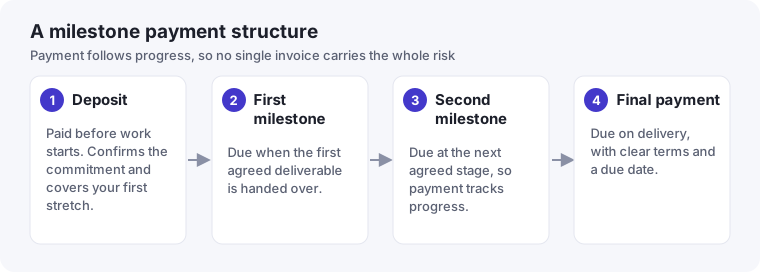
Requiring a deposit before starting work — commonly a third to half of the total project value — does two things at once: it reduces how much of the project's value is exposed to a late or non-payment, and it filters out clients who aren't serious, since a client unwilling to pay a deposit is often also the one most likely to be difficult about the final invoice. For freelancers who've never required deposits, this is usually the single most impactful change to make first.
Splitting larger projects into milestones
Rather than one invoice at the end of a multi-week project, splitting payment across milestones — start, midpoint, completion — means a delay at any single stage affects a smaller amount, and you find out about a client's payment reliability early, while there's still time to adjust how you proceed with the rest of the project.
Retainers for recurring clients
For clients you work with regularly, a retainer — a fixed recurring payment for ongoing availability or a set amount of work — creates predictable income and removes the need to invoice and chase payment for every individual task. This isn't the right fit for every client relationship, but for recurring work it removes a significant amount of billing overhead entirely.
Shorter payment terms as the default
Net-30 payment terms are common but not mandatory — many freelancers default to this simply because it's what they've seen elsewhere. Net-15 or even due-on-receipt terms are entirely reasonable to propose, particularly for newer clients without an established payment history with you. It's far easier to extend more generous terms to a client who's proven reliable than to tighten terms after a payment problem has already occurred.
What automation can and can't fix here
The automated follow-up features covered in our invoicing tools guide help with invoices that were simply forgotten, but they don't fix a structural problem — a client who consistently pays late regardless of reminders, or payment terms that don't match the reality of your cash flow needs. If reminders alone aren't solving the pattern with a specific client, the terms themselves, not the reminder system, are what needs to change.
The goal of all of this isn't to eliminate late payments entirely — that's not fully within your control. It's to structure your business so that when one does happen, it's a manageable inconvenience rather than a genuine emergency.
Introducing new terms with existing clients
Changing payment structure mid-relationship with an existing client feels more awkward than setting terms with someone new, but it's more common — and better received — than most freelancers expect. Framing it as a standard business update rather than a response to any specific problem helps: "I'm updating my standard process for new projects going forward to include a deposit — wanted to flag that before we scope the next one." Most established, reasonable clients accept this without friction, especially when it's presented as a general policy rather than something specific to them.
How this connects to your overall pricing conversation
Payment structure and pricing level are related but separate decisions. A freelancer charging too little can have perfect payment terms and still struggle financially, while a well-priced freelancer with poor payment structure can experience cash flow problems despite healthy revenue on paper. Both matter, but they're solved differently — one through protecting your scope and pricing accuracy project to project, the other through the structural changes covered here. Treating a cash flow problem as purely a pricing issue, or purely a payment-terms issue, often means missing half of the actual fix.
A worked example with hypothetical numbers
Imagine a project priced at 3,000 in your currency, delivered over six weeks. Compare two payment structures:
| Structure | Payments | If the final payment is 30 days late |
|---|---|---|
| Single invoice at the end | 3,000 on delivery | You have received nothing for six weeks of work, plus another month of waiting |
| 30% / 40% / 30% | 900 upfront, 1,200 at the midpoint, 900 on delivery | You have already received 2,100, and the late amount is 900 |
The total is the same, but the risk is very different. The second structure means that a late payment is an irritation, not a threat to your ability to pay your own bills. The percentages here are examples only; choose a split that suits your kind of work and your clients.
A calm timeline for late invoices
Having a routine for late payments removes the awkwardness of deciding what to do each time. A simple sequence might look like this, adjusted to your payment terms:
| When | Action |
|---|---|
| A few days before the due date | Friendly reminder with the invoice attached |
| Day after the due date | Short, polite note asking whether anything is blocking payment |
| One week late | Firmer message that restates the terms and asks for a payment date |
| Two weeks late | Phone call or direct conversation, and pause new work if the terms allow it |
| Beyond that | Follow the process set out in your contract, and consider professional advice |
Put the terms where the client will see them
Payment terms only protect you if they are visible. Include them in the proposal, in the contract, and again on each invoice, in plain language: how much is due when, how the client can pay, and what happens when a payment is late. A client who has read and agreed to the terms will rarely be surprised, and if a dispute does arise, you will have a clear record to point to. Requirements about late-payment fees and interest differ by country, so check what applies to you.